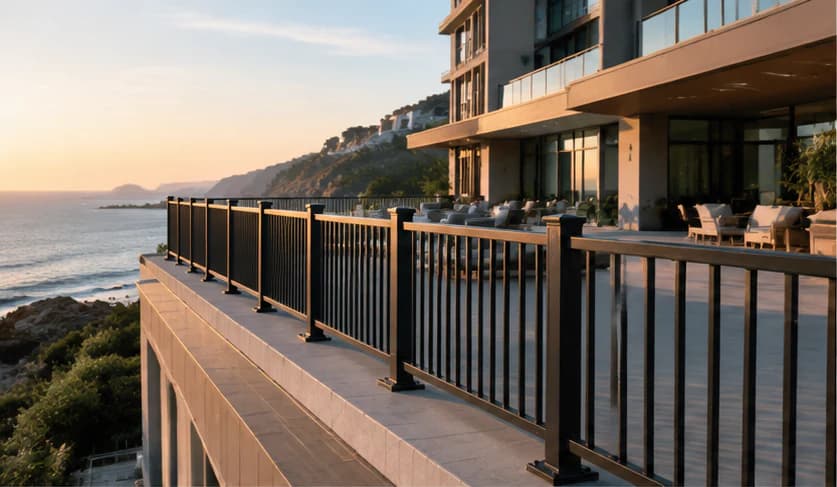
A practical guide to specifying aluminum alloy, architectural coating performance, factory quality control, export packing and maintenance for coastal and commercial railing projects.
Quick answer
Powder-coated aluminum can be a practical railing material for balconies, terraces, resorts, residential developments and many coastal projects, but “powder coated” is not a complete specification. Buyers should define the aluminum alloy and temper, profile dimensions, structural design basis, pretreatment, coating performance class, color and gloss, cut-edge treatment, fastener compatibility, inspection method and maintenance plan. The final system must also be checked against the governing building code and project engineer's requirements.
Introduction
An aluminum railing quotation can look straightforward: posts, rails, vertical pickets, brackets, a black finish and a price per meter. In practice, the performance of the finished system depends on decisions that are often hidden behind those short descriptions.
Two suppliers may both quote a “black powder-coated aluminum railing,” yet propose different alloys, wall thicknesses, pretreatment processes, coating systems, cure controls, fasteners and packing methods. Those differences may not be visible in a small PDF rendering. They become visible later as color variation, poor fit, coating damage, installation delays or premature finish deterioration.
This guide is written for architects, contractors, developers, distributors and international buyers who need a repeatable way to specify and inspect aluminum railing systems. It does not replace structural engineering or local code review. Instead, it shows which questions should be resolved before production, what evidence can be checked at the factory and how to prepare the order for export and installation.
Is powder-coated aluminum railing suitable for coastal areas?
It can be, provided the complete system is selected for the actual exposure. Aluminum naturally forms a thin oxide layer, which gives it useful corrosion resistance, while a properly prepared architectural coating adds color and another protective barrier. However, salt deposition, humidity, ultraviolet exposure, pool chemicals, industrial contamination and infrequent cleaning can make one “coastal” location much more demanding than another.
Distance from the sea is only one input. A sheltered balcony several kilometers inland may still collect salt carried by prevailing wind. A railing close to breaking surf may receive direct salt spray. A pool deck may have chlorinated water and frequent wetting. A high-rise balcony can also combine salt exposure with stronger wind, difficult access and long maintenance intervals.
For that reason, avoid a universal statement such as “aluminum never corrodes” or “any powder coating is coastal grade.” Ask the project specifier to define the exposure, expected cleaning regime, required design life and applicable finish standard. Then ask the manufacturer or coating applicator to confirm, in writing, the pretreatment and coating system proposed for that condition.
Start with the railing system, not the finish color
The coating protects and colors the product, but it cannot correct an under-designed railing. Before discussing RAL black, textured bronze or gloss level, define the assembly.
Confirm the governing design information
The request for quotation should identify:
- project country, city and site exposure;
- applicable building code and project specification;
- guard height and handrail requirements;
- residential, commercial, hospitality or public-use occupancy;
- required line, point or infill loads as determined by the responsible designer;
- floor-mounted or side-mounted posts;
- post spacing and panel module;
- infill type, such as vertical pickets, glass or another approved element;
- base material and anchor substrate;
- stair angles, corners, gates, transitions and termination details;
- tolerances and interfaces with waterproofing, tiles, concrete edges or steel framing.
The Aluminum Association publishes the *Aluminum Design Manual* as a structural design resource for aluminum components. Its existence is a useful reminder that alloy, temper, geometry, welding and connection design work together; material name alone is not a structural calculation.
Define alloy, temper and profile geometry
Extruded architectural railing components are often made from 6xxx-series aluminum because these alloys can combine extrudability, finish quality and useful mechanical properties. HOOPROSP's current aluminum glass channel, for example, lists 6063-T5 as a product reference. A vertical-picket railing may use a different temper or profile geometry depending on its span, connection and loading.
Do not copy an alloy from another project without checking the design. The buyer's approved drawing should record:
- alloy and temper;
- post, rail and picket outside dimensions;
- nominal wall thickness;
- internal reinforcement where required;
- weld locations or mechanical connection details;
- base-plate thickness and hole pattern;
- fastener material and isolation method;
- allowable dimensional tolerances.
A sample cut section or “golden sample” can be more useful than a catalog image. It allows the buyer to verify profile shape, wall thickness, corner radii, surface appearance and the way mating components fit.
What do AAMA 2603, 2604 and 2605 mean?
In North American architectural specifications, the AAMA 2603, 2604 and 2605 series is commonly used to define progressively different performance requirements for organic coatings on aluminum extrusions and panels. In 2026, FGIA announced updated AAMA 2603-26, 2604-26 and 2605-26 documents. FGIA describes 2604 as a high-performance coating specification and 2605 as a superior-performing coating specification.
That classification is more useful than asking only for a coating thickness. The standards address test procedures and performance requirements for the coating system, not simply how many microns appear on a gauge. The correct class depends on the project specification, exposure, color-retention expectations, warranty conditions and coating technology.
A practical way to discuss the classes
- AAMA 2603: often considered for less demanding architectural applications where the project specification accepts its performance level.
- AAMA 2604: frequently specified for exterior architectural components requiring a high-performance organic coating.
- AAMA 2605: used where the project requires the superior-performing class and its associated test requirements.
These descriptions are not permission to substitute one class for another. Obtain the current standard, follow the project documents and confirm that the proposed powder or liquid coating system and applicator can support the specified class. A powder supplier's product data sheet is not automatically proof that every finished railing leaving a factory complies; application, pretreatment, curing and in-process control also matter.
Powder coating vs anodizing for aluminum railings
Neither finish is universally better.
Anodizing is an electrochemical process that develops a controlled aluminum oxide layer from the substrate. It preserves a metallic character and creates an integral finish. The AAMA 611 series is commonly referenced for anodized architectural aluminum.
Powder coating applies a dry organic coating electrostatically and cures it into a continuous film. It provides a broad color and texture range and can coordinate railings with window frames, façade elements and brand palettes.
Choose between them by asking:
- Is the design intent metallic or an opaque solid color?
- Does the project specification name a finish standard?
- What weathering, color and gloss retention are required?
- Can the chosen applicator process the complete component size after fabrication?
- How will welding, cutting, drilling and field touch-up affect the finish?
- What sample size and approval lighting will be used?
Anodized finishes can show normal appearance variation related to alloy, extrusion, surface treatment and viewing conditions. Powder coatings can also vary between batches, applicators, gloss levels and textures. For either route, approve a physical sample rather than relying only on a digital RAL representation.
Why pretreatment and curing matter
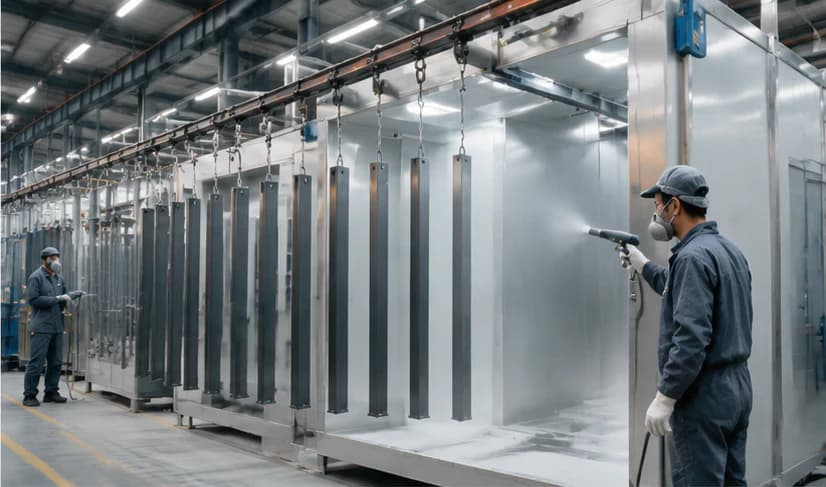
A premium powder name cannot compensate for contamination, weak pretreatment or incorrect curing. The Aluminum Extruders Council notes that architectural coating systems are defined through recognized specifications and that powder coatings provide a broad range of appearance and performance options.
A controlled factory process normally includes several linked stages:
- Incoming surface review. Profiles should be checked for extrusion lines, dents, oil, oxidation and handling damage.
- Cleaning and pretreatment. The exact process depends on the coating system and specification. Its purpose is to create a clean, appropriately prepared surface for adhesion and corrosion performance.
- Drying. Water trapped in joints or cavities can create defects.
- Powder application. Booth control, grounding, gun setup and part orientation influence coverage, especially at corners, welds and recesses.
- Curing. The part must reach the coating supplier's specified metal temperature for the required time. Oven air temperature alone is not enough evidence.
- Cooling, inspection and protected handling. Finished parts need clean supports and separators so the approved surface is not damaged before packing.
For a project order, ask what process records are available. Depending on scope, these may include batch identification, pretreatment checks, coating-batch data, cure records, dry-film measurements, adhesion results, color/gloss checks and nonconformance records. Do not request every possible test by default; define the required inspection plan before quotation so the supplier can price and schedule it.
A buyer's factory quality-control checklist
1. Drawing and sample approval
Production should follow an approved revision. Confirm that the drawing number on the factory traveler, packing list and inspection report matches the released version. Approve the profile section, connection method and physical finish sample before bulk fabrication.
2. Material verification
Check the material certificate or supplier declaration required by the contract. Verify alloy and temper markings against the purchase specification. Measure critical profile dimensions and wall thickness on a defined sample.
3. Fabrication inspection
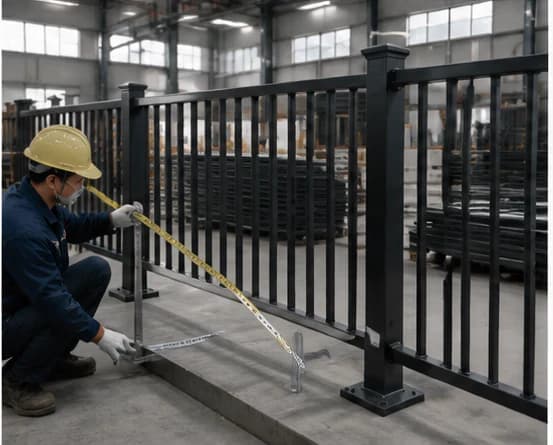
Review cut lengths, hole positions, squareness, weld appearance, base-plate alignment and mating-part fit. A trial assembly of a representative straight bay, corner and stair section can identify interface problems before hundreds of components are packed.
4. Coating inspection

Use the approved sample and inspection procedure to review:
- color and gloss under agreed lighting;
- complete visible coverage;
- pinholes, craters, dirt inclusions, orange peel and runs;
- thin coverage at corners or complex recesses;
- chips, scratches and rack marks;
- dry-film readings where required;
- adhesion or cure checks specified in the inspection plan.
Acceptance limits should be written. “Good finish” is subjective; an inspection distance, lighting condition, approved sample and defined defect criteria make release decisions more consistent.
5. Hardware compatibility
Confirm fastener grade, dimensions and quantity. Where dissimilar metals meet, the project designer should define isolation and drainage details appropriate to the environment. Trapped water at a base plate or unsealed cut edge can create a local durability problem even when the visible coating looks excellent.
6. Packing inspection
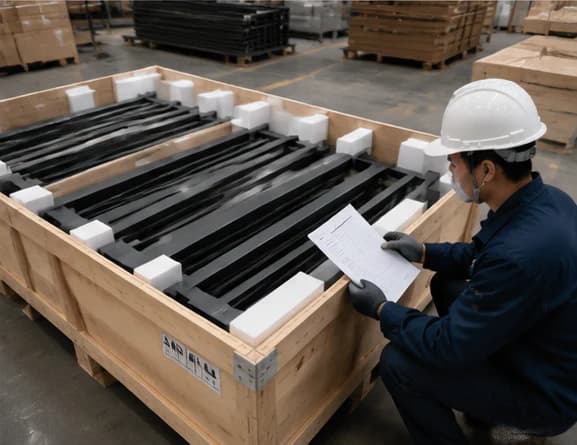
Inspect protection only after confirming the product is clean and dry. Soft, non-abrasive interleaving should prevent face-to-face rubbing. Posts, rails, panels, base covers and hardware should be separated and labeled by elevation, floor, zone or installation sequence. Heavy components must not load fragile trim pieces inside the same crate.
Photograph the first approved packing arrangement and use it as the packing standard. Before container loading, confirm package count, gross dimensions, center of gravity where relevant, moisture protection, crate condition, labels and the way packages will be restrained.
Installation preparation prevents finish damage
Many coating complaints begin during site handling rather than at the coating line. Rail sections dragged across concrete, tightened with unprotected tools or cut with abrasive debris left on the surface can lose the protection achieved at the factory.
The installation package should include:
- approved shop drawings and setting-out dimensions;
- anchor schedule and substrate requirements;
- component and hardware list;
- zone-based packing list;
- recommended lifting and handling method;
- instructions for drilling, cutting and touch-up, if field modification is permitted;
- cleaning and maintenance guidance;
- procedure for recording transit damage or shortages.
Before bulk installation, assemble a sample bay on the actual substrate. Check post alignment, cover fit, picket spacing, corner transitions, drainage and tool access. Any project-specific correction should be incorporated into the controlled drawing and installation method, not passed informally between crews.
Mid-article CTA — Send Your Requirements Planning an aluminum railing for a resort, residential development or commercial terrace? Send the project location, elevation drawing, finish requirement and estimated quantity. HOOPROSP can review the manufacturing scope and identify the information needed for a comparable quotation. Button: Send My Railing Requirements
Maintenance should be part of the specification
“Low maintenance” does not mean “no maintenance.” Dirt, salt and pollutants should not be allowed to build up indefinitely. Cleaning frequency depends on exposure, rainfall, accessibility and the finish supplier's guidance.
At handover, provide a simple maintenance document that identifies:
- recommended cleaning interval for the site exposure;
- mild cleaning agents and soft tools that are permitted;
- abrasive products, aggressive chemicals or high-pressure methods to avoid;
- inspection of coating damage, loose fasteners and drainage points;
- approved touch-up approach for minor installation damage;
- escalation process for widespread coating change or structural movement.
The maintenance note should align with the coating supplier and applicator instructions. It should not promise a fixed service life independent of environment and care.
Information to send for an accurate quotation
A useful aluminum railing RFQ includes:
- project name, country and site exposure;
- architectural elevations, plans and details in PDF and, where available, CAD format;
- railing type, height, post spacing and total quantity;
- alloy/temper or performance requirement;
- profile dimensions and wall thickness, if already specified;
- design loads and governing code supplied by the responsible project team;
- mounting substrate and anchor responsibility;
- infill type and dimensions;
- coating standard, color, gloss and texture;
- physical sample or approved color reference;
- factory testing and inspection requirements;
- packing sequence, shipping destination and required Incoterm;
- target production and delivery schedule.
If some items are unknown, label them “to be confirmed” rather than allowing different suppliers to make different hidden assumptions. A quotation comparison is only meaningful when scope and exclusions are visible.
FAQ
Is AAMA 2605 always required for a coastal aluminum railing?
No universal rule applies to every location. The project specification, environmental exposure, coating technology, maintenance plan and local requirements should determine the finish class. AAMA 2605 is the superior-performing organic coating class in the FGIA series, but buyers should not replace the project specifier's decision with a generic distance-from-coast rule.
Is powder-coated aluminum maintenance free?
No. It normally requires less routine refinishing than many field-painted alternatives, but periodic cleaning and inspection remain important. Salt, construction dust and pollutants should be removed using methods approved by the finish supplier.
What aluminum alloy is best for railings?
There is no single best alloy without a design context. 6xxx-series alloys are common in extruded architectural products, but the final alloy, temper, profile geometry and connection design must satisfy the engineering and fabrication requirements.
Can coating thickness prove that the finish is high quality?
Thickness is one useful inspection input, not proof by itself. Surface preparation, pretreatment, powder chemistry, cure, adhesion, edge coverage, color control and handling all contribute to performance. Evaluate the coating against the specified system and test plan.
Should the railing be coated before or after fabrication?
The correct sequence depends on the design, welding, component size, coating line and appearance requirements. Coating after fabrication can provide a continuous finish over completed work, while component-based finishing may simplify handling. Resolve the sequence with the manufacturer and coating applicator before approving the drawings.
What should a pre-shipment inspection cover?
It should cover the approved drawing revision, quantity, dimensions, workmanship, finish, hardware, trial assembly where specified, labels, packaging and shipment readiness. The scope and sampling method must be agreed before production.
Conclusion
A reliable powder-coated aluminum railing begins with a complete system specification. Alloy, temper, profile geometry, loads, connections, pretreatment, coating class, curing, inspection, packing, installation and maintenance are connected decisions.
The most effective buyer workflow is simple: define the project exposure, release a controlled drawing, approve a physical finish sample, agree on inspection criteria, trial-assemble critical interfaces and inspect the packed order before shipment. That process creates better quotations and fewer surprises than relying on a finish name or product rendering alone.
Final CTA — Get a Quote Send HOOPROSP your railing drawing, project location, finish reference, quantity and destination. We will help organize the manufacturing questions that should be confirmed before a project quotation. Button: Get an Aluminum Railing Quote