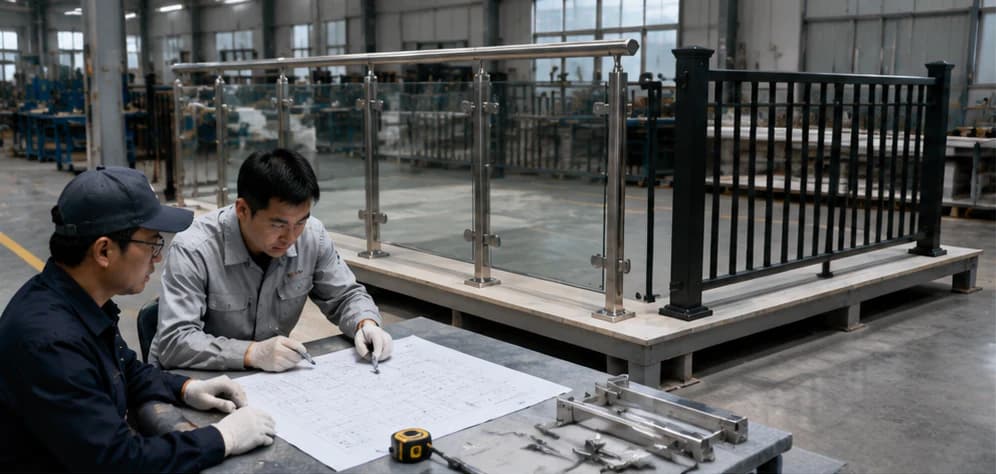
A drawing-first procurement guide covering supplier evaluation, samples, factory testing, inspection hold points, export packaging and shipment coordination for custom railing projects.
Quick answer
To source custom railings from China with controlled risk, begin with a written project brief and approved drawings, not a catalog photo. Compare suppliers on material control, fabrication capability, drawing discipline, finish process, testing access, trial assembly, inspection transparency, packaging and export coordination. Define who is responsible for local code compliance and structural engineering, approve a sample or first article, establish inspection hold points and release shipment only against agreed acceptance criteria.
Introduction
International railing procurement is not simply a search for the lowest price per meter. A railing is a system of posts, rails, glass or pickets, brackets, anchors, finishes and interfaces with the building. A difference of a few millimeters at a base plate, a missing gasket or a poorly labeled crate can cost more to correct on site than it saved at purchase.
China has a deep network of aluminum extrusion, stainless steel fabrication, glass hardware, coating, packaging and logistics suppliers. That capacity can support standard components and highly customized project orders. It also means the buyer needs to identify which organization controls the critical processes and how information moves between them.
This guide gives contractors, distributors, developers and project buyers a practical sourcing workflow. It does not claim that one country, factory certificate or inspection method guarantees quality. It explains how to build a verifiable scope so both buyer and manufacturer understand what must be produced, checked and shipped.
1. Decide whether you need a component supplier or a project manufacturer
The word “manufacturer” can describe very different businesses.
Component supplier
A component supplier may specialize in standard spigots, clamps, brackets, posts, channels or fasteners. This can be efficient when the buyer already has an engineered system, a complete bill of materials and local fabrication or installation capability.
System supplier
A system supplier provides compatible posts, rails, infill supports, covers and hardware. It may offer standard modules and installation details but still rely on the buyer's engineer for project-specific loading and anchor design.
Custom project fabricator
A custom fabricator works from approved shop drawings and may cut, drill, weld, polish, coat, trial-assemble, label and pack project-specific assemblies. It needs stronger drawing control and typically has more pre-production work than a stock component order.
Choose the model that matches the project. A small distributor replenishing standard glass clamps should not carry the same drawing overhead as a hotel with curved stairs and multiple balcony types. A complex project should not be reduced to a generic component quotation.
2. Build a clear request for quotation
The first quotation is only as comparable as the information sent to each supplier. A useful RFQ package should separate confirmed requirements from items still under design.
Project and commercial information
Include:
- project name or confidential reference;
- destination country, city and site conditions;
- project type and occupancy;
- estimated quantity by railing type;
- target sample, production and delivery dates;
- requested Incoterm and named place or port;
- packaging, labeling and shipment-sequence expectations;
- required quotation validity and currency.
Technical information
Provide:
- plans, elevations, sections and details;
- railing height, post spacing and module layout;
- stainless steel, aluminum or mixed-material scope;
- material grade, alloy and temper where specified;
- finish, color, gloss and sample reference;
- glass make-up or picket/cable infill;
- mounting method and substrate;
- project design loads and governing code from the responsible design team;
- anchor scope and waterproofing interfaces;
- tolerances, visible-face criteria and site constraints;
- required test reports, certificates, samples or mock-ups.
Avoid sending only a rendering. It communicates appearance but rarely defines thickness, hidden connections, tolerances or responsibility. If the design is preliminary, ask for a budget quotation with listed assumptions. Later, replace those assumptions with an approved technical package before production.
3. Evaluate the supplier beyond the website
A good-looking website and a business license answer only basic questions. Supplier evaluation should focus on the processes that create the product you need.
Confirm the legal and commercial entity
Check the company name on the quotation, bank account, contract, invoice and export documents. Ask which entity manufactures, which entity exports and whether subcontractors handle major operations. Where risk or order value justifies it, use independent business verification and legal review.
Map the manufacturing process
For the proposed product, identify who controls:
- extrusion or tube supply;
- laser cutting, sawing and machining;
- welding and grinding;
- stainless steel polishing or PVD finishing;
- aluminum pretreatment and powder/liquid coating;
- hardware and gasket procurement;
- trial assembly;
- inspection and testing;
- packaging and container loading.
Outsourcing is not automatically a problem. The key question is how specifications, samples, batch identity, inspections and nonconformities are controlled across the chain.
Review relevant evidence
Ask for evidence that matches the offered scope, such as:
- photographs or video of similar production processes;
- anonymized sample drawings and inspection forms;
- material traceability procedure;
- calibration status for key measuring equipment;
- finish-line or applicator documentation;
- product test reports that clearly identify the tested configuration;
- packaging examples for comparable dimensions;
- quality-system certifications where contractually relevant.
A certificate should be checked for issuer, scope, site, validity and relevance. It does not replace product inspection. A test report for one post spacing, glass thickness or anchor condition should not be presented as proof for every possible configuration.
4. Use a drawing-first approval process
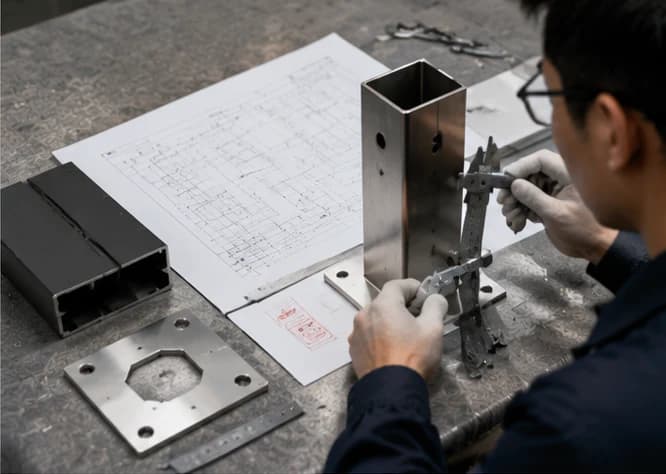
The controlled drawing is the bridge between design intent and factory production. It should state what is made, how components connect and which revision is approved.
Establish drawing responsibility
Clarify who prepares and approves:
- design drawings;
- structural calculations;
- shop drawings;
- glass schedules;
- anchor calculations;
- fabrication drawings;
- installation method statements;
- as-built information.
The overseas manufacturer can provide manufacturing input and shop drawings, but the local licensed professional and project team retain the responsibilities assigned by the governing contract and jurisdiction. Do not assume a supplier's standard detail is automatically code compliant for a new building, load or substrate.
Control revisions
Every drawing should have a number, revision and status. The purchase order should reference the released revision. Changes after sample approval must be documented with cost, lead-time and inventory impacts.
A practical approval sequence is:
- buyer issues RFQ drawings;
- supplier returns questions and assumptions;
- supplier prepares shop/manufacturing drawings;
- buyer, architect and engineer review as required;
- supplier revises and submits a controlled version;
- authorized party releases “approved for production” status;
- factory traveler and inspection plan reference the same revision.
Screenshots in messaging apps are useful for discussion but should not become the only production instruction.
5. Approve samples and first articles deliberately
The correct sample depends on risk.
Material and finish sample
Use this to approve stainless grade appearance, polishing direction, powder-coated color, gloss, texture, anodizing or PVD tone. Make the sample large enough to judge the finish and record its ID.
Component sample
A post, base plate, bracket, clamp, gasket or profile cut section can verify dimensions, machining, material and fit.
Full-size sample bay
For a custom railing, assemble a representative section with the actual post, rail, infill support, base cover, fasteners and finish. Include a corner, stair transition or complex detail if that is where risk is concentrated.
First article
The first article is made using the intended production process after drawings are released. Inspect it before bulk production. The goal is not to create a showroom piece under different conditions; it is to prove that normal production can meet the approved requirements.
Record what the sample approves and what it does not. A color sample does not approve structural performance. A visual railing bay does not validate anchors in the project substrate unless the required engineering or testing also covers them.
6. Define testing according to the actual configuration
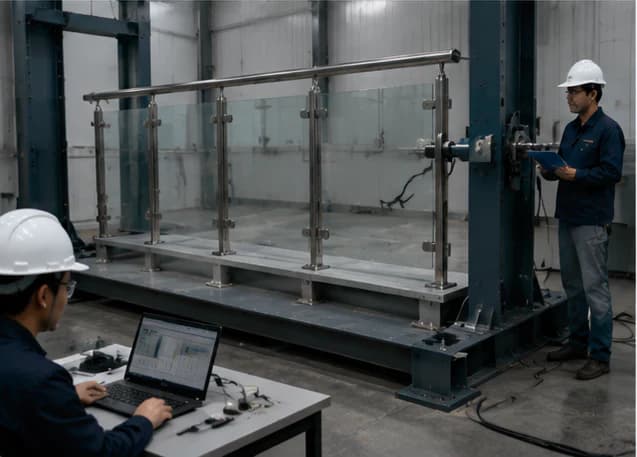
Railing requirements vary by jurisdiction, occupancy and system type. The buyer should provide the governing criteria and agree on the evidence required.
Potential verification may include:
- engineering calculations by an appropriately qualified professional;
- dimensional and material checks;
- static load testing of a representative railing assembly;
- glass or infill retention checks;
- anchor testing or substrate-specific validation;
- weld inspection appropriate to the design and contract;
- coating tests and finish inspection;
- corrosion-related testing when specified;
- trial assembly and functional checks for gates or adjustable components.
Do not ask for a generic “CE,” “ASTM” or “code-compliant” certificate without defining the product and requirement. Standards contain specific scopes and methods. For example, an ICC-ES evaluation report identifies the exact evaluated railing system and conditions; it is not a universal certificate for all glass railings.
When reviewing a report, check:
- test laboratory and accreditation information;
- report date and validity where applicable;
- product name and configuration;
- post spacing, height, infill and fasteners;
- substrate and anchors;
- applied loads and test method;
- acceptance criteria and result;
- modifications between the tested sample and quoted product.
If the project requires new testing, add its cost, sample quantity and schedule before the purchase order is finalized.
Mid-article CTA — Ask for a Project Review Have a railing drawing or bill of materials? Send the product type, finish, quantity, destination and required test scope. HOOPROSP can help organize the manufacturing questions and quotation inputs before production. Button: Send Your Requirements
7. Plan inspections as production hold points
Inspection works best when it is planned before defects are expensive to correct.
Pre-production meeting
Review the approved drawings, sample, critical dimensions, finish, test scope, packing and schedule. Confirm who can approve deviations and how they are recorded.
Incoming-material and first-process checks
Verify material identity, profile section, wall thickness and critical hardware before large quantities are fabricated. Inspect the first cut, first drilled part, first weld or first finished component where it represents a repeatable process.
During-production inspection
For complex or high-volume orders, inspect while enough units are complete to show process consistency but while correction is still possible. Review dimensions, jigs, workmanship, finish preparation, batch control and status against schedule.
Pre-shipment inspection
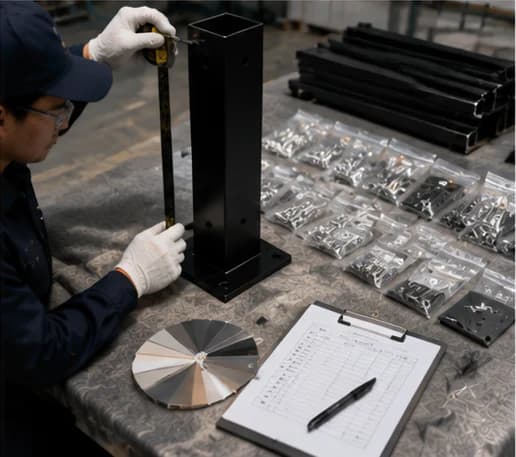
Inspect when production is substantially complete and sufficient goods are packed for packaging review. The inspection checklist should cover:
- order and drawing revision;
- quantity by item and zone;
- dimensions and tolerances;
- material and finish records;
- visual workmanship;
- representative assembly fit;
- hardware quantities and compatibility;
- labels and packing list;
- package protection and crate construction;
- required documents and open nonconformities.
For sampled inspection, ISO 2859-1:2026 provides AQL-indexed schemes for lot-by-lot inspection by attributes. The buyer must still define inspection level, AQL, defect categories and special handling of critical characteristics. AQL is not a promise that every product is defect free, and it should not be used casually for safety-critical attributes.
Independent inspection
A third-party inspector can provide useful separation when the buyer cannot attend, the order is high value, the supplier is new or a financing/contract condition requires independence. The inspector needs the same controlled documents as the factory. A generic checklist without drawings, approved samples or defect criteria will produce a generic report.
8. Treat packaging as part of the product
Export railings may pass through factory handling, trucking, consolidation, port operations, ocean freight, customs inspection, destination warehousing and site delivery. The visible finish and installation sequence must survive that chain.
Protect each finish appropriately
Satin stainless steel should be protected from rubbing that changes the grain. Mirror surfaces need clean film and separation. Powder-coated aluminum should not contact abrasive foam, staples or metal banding. Glass-related gaskets and small hardware should be sealed, counted and kept away from moisture or contamination.
Design crates around handling
The package should support the component at strong points. Long rails need support against bending. Panels need restraints that do not concentrate pressure on pickets or decorative infill. Heavy base plates should not move against finished posts.
Label for installation, not only customs
Useful labels include:
- project reference;
- elevation, floor, zone or unit;
- package number and total package count;
- item codes and quantity;
- gross/net weight where required;
- dimensions and handling orientation;
- fragile, keep dry or lifting-point markings where applicable.
The packing list should allow the receiving team to locate a missing bracket without opening every crate. For phased projects, load containers in a sequence aligned with site access where practical.
Conduct a shipment inspection
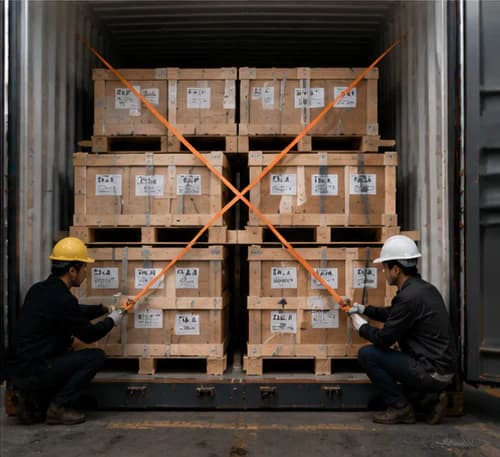
Before release, photograph representative packing, sealed crates and the container-loading arrangement. Check container condition, moisture, restraint, package count and door closure. Keep the records with the commercial documents and inspection report.
9. Clarify Incoterms, freight and import responsibilities
Incoterms allocate specified delivery tasks, costs and risks between seller and buyer; they do not by themselves define product quality, payment security, title transfer or every customs obligation. Use the current agreed Incoterm with a named place or port and confirm it with the freight forwarder and contract adviser.
Questions to resolve include:
- who books main carriage;
- who handles export clearance;
- where risk transfers;
- who arranges cargo insurance and to what level;
- destination terminal and handling charges;
- import permits, duties and taxes;
- required certificates or product documents;
- container type, loading limits and oversized packages;
- demurrage, detention and site-delivery constraints.
Request a packing estimate early. A railing's cubic volume, crate shape and loading sequence may influence freight more than product weight. Late packaging changes can alter both shipping cost and site handling.
10. Manage payment and change control
Payment terms should reflect the relationship, customization level, tooling, material commitment and inspection hold points. Use a written contract or purchase order that identifies:
- approved scope and drawings;
- price and currency;
- deposit and balance milestones;
- sample, tooling and testing charges;
- inspection and release conditions;
- change-order process;
- lead-time assumptions;
- warranty terms and exclusions;
- treatment of nonconforming goods;
- dispute resolution and governing law;
- confidentiality and drawing ownership where required.
Do not change bank details based on an unexpected email without independent verification through a known contact. For material scope changes, request a revised quotation and drawing rather than relying on an informal promise.
11. Prepare the installation team before arrival
Procurement success is measured at installation, not at container departure. Before shipment, provide the site team with:
- final approved shop drawings;
- packing list and crate map;
- anchor and substrate requirements;
- component schedule;
- installation method and sequence;
- special tools and consumables;
- touch-up and cleaning instructions;
- procedure for shortages, transit damage and nonconformities.
Confirm site dimensions and substrate readiness before custom lengths are released. Where practical, complete a local sample installation before the full shipment. This exposes tolerance, waterproofing, anchor-access and tool-clearance issues while they can still be managed.
Supplier evaluation scorecard
FAQ
How do I verify that a Chinese railing supplier is a real factory?
Confirm the legal entity, address and commercial documents; review the production processes relevant to your product; conduct a live video or site audit where justified; and identify outsourced operations. Factory status alone does not guarantee quality, so continue with drawing, sample and inspection controls.
Should I buy directly from a factory or through a trading company?
Either model can work. A factory may offer direct process access, while a capable trading or project-management company may coordinate several specialized processes. Evaluate responsibility, technical communication, quality control, transparency and contract structure rather than the label alone.
What files should I send for a custom railing quotation?
Send PDF drawings plus CAD/BIM files where available, a product schedule, material and finish requirements, quantities, project location, design criteria, mounting substrate, testing needs, packing sequence and delivery target. Mark unresolved items clearly.
Who is responsible for local code compliance?
Responsibility follows the contract and local law. The project architect, engineer and licensed professionals normally define and approve the governing requirements. The manufacturer must produce the approved scope and provide agreed evidence, but its standard detail should not be assumed to replace local design approval.
Is a pre-shipment inspection enough?
Not by itself. Final inspection is strongest when it follows approved drawings, samples, process controls and earlier hold points. Some defects cannot be corrected efficiently after an entire order is finished.
What is an acceptable AQL for railings?
There is no universal AQL for every characteristic. Buyer and supplier should agree on sampling, inspection level, defect classification and acceptance numbers. Safety-critical or regulatory characteristics may require different controls from cosmetic workmanship.
How can I prevent parts from being mixed between building zones?
Use a controlled item code tied to drawings, mark each component or package, create zone-based packing lists and inspect labels before loading. Ask the supplier to photograph the first approved packing and representative loaded crates.
Conclusion
Sourcing a custom railing system from China is manageable when the project is controlled through evidence rather than assumptions. The essential sequence is to define the scope, evaluate the actual process, release controlled drawings, approve representative samples, verify the correct configuration, inspect at planned hold points and package the order for its real shipping and installation journey.
Price remains important, but the lowest apparent price may exclude drawing work, testing, hardware, surface protection, labeling or inspection. A transparent quotation with assumptions and exclusions gives buyers a stronger basis for negotiation and project planning.
Final CTA — Get a Quote Send HOOPROSP your drawings, material and finish requirements, quantity, destination and timeline. We will review the available information and identify the points that should be confirmed for a focused manufacturing quotation. Button: Request a Custom Railing Quote