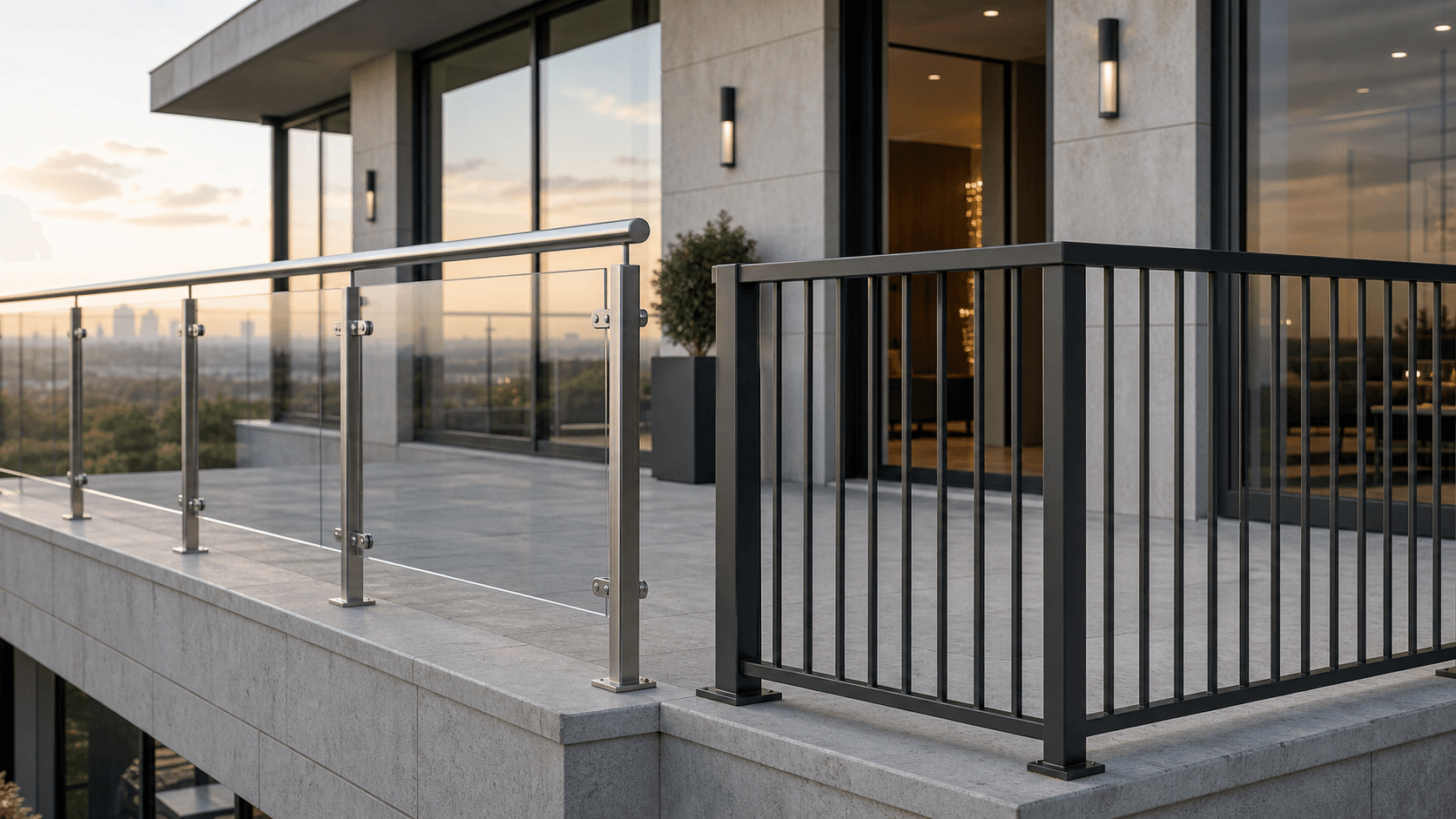
A practical B2B comparison of stainless steel and aluminum railing systems, covering exposure, finish, installation and project delivery decisions.
Introduction
Short answer: stainless steel is usually selected where a slim, premium metal appearance, high local strength and compatible stainless hardware are priorities; aluminum is often selected where low weight, modular fabrication, colour choice and efficient installation matter most. Neither material is automatically “best.” The correct decision depends on exposure, system design, fixing substrate, code loads, finish and the buyer’s maintenance plan.
For an importer or contractor, this decision is rarely about a single metre of railing. It affects freight volume, site handling, installation sequence, spare parts and the consistency of a development. In our project discussions, the useful starting point is not “Which material is stronger?” It is: what must the complete guard system do at this location, and what documents must support it?
This guide explains how to compare stainless steel and aluminum railing systems for balconies, terraces, stairs and commercial walkways. It is intended for early-stage procurement and does not replace local code review or project-specific structural engineering.
Compare the system before comparing the metal
A railing is a connected system: posts or base shoes, handrails, infill, brackets, anchors, welds or mechanical joints and the supporting structure. A post made from one material does not prove that the full assembly is suitable for a particular guard load.
Before requesting a quotation, prepare these five items:
- Site drawings with finished-floor levels and mounting zones.
- Applicable local code, required rail height and design loads.
- Exposure information: inland, humid, poolside, coastal or industrial.
- Preferred infill: glass, vertical pickets, cable, perforated panel or mesh.
- Required finish, quantity, delivery country and installation programme.
When buyers supply this information early, a supplier can propose sensible post centres, bracket types, end conditions and packing instead of pricing a generic picture.
Stainless steel railings: where they fit well
Stainless steel is commonly specified for visible handrails, glass clamps, spigots, fittings and post-and-rail systems. Its appeal is the clean metallic finish and the ability to create compact details where the grade, wall thickness, connection design and fabrication are appropriate.
Grade is an exposure decision
“Stainless” does not mean maintenance-free or suitable for every environment. Grade selection should consider chlorides, trapped moisture, cleaning chemicals, airborne pollution and contact with dissimilar metals. For many interior and ordinary exterior applications, buyers may consider 304-grade stainless components. Projects with marine influence, pool chemicals or persistent chloride exposure often need a more conservative material and detailing review, commonly including 316-grade options.
The grade alone is not the answer. Crevices that hold dirty water, unsealed cut edges, aggressive cleaners and incompatible fasteners can all reduce long-term appearance. On coastal enquiries, we ask for distance from the shoreline, prevailing exposure and whether salt deposits can be rinsed during maintenance. That discussion is more valuable than promising that any material will never stain.
Fabrication and finish matter
For visible railings, a consistent satin, brushed or mirror finish requires controlled handling after fabrication. Weld discolouration should be cleaned and passivated where appropriate; sharp edges should be removed; and components should be separated in transport to prevent rubbing. During shipment inspection, practical checks include surface consistency, tube straightness, bracket orientation, thread protection and carton labels against the packing list.
Practical advantages
- Premium metallic appearance for hospitality, villas and commercial entrances.
- Good compatibility with stainless glass clamps, handrail brackets and fasteners.
- Strong, slim-looking details when properly engineered.
- Readily cleanable surfaces with a suitable maintenance routine.
Points to control
- Specify grade, tube section/wall thickness and finish rather than simply writing “SS.”
- Avoid uncontrolled contact with carbon steel and manage galvanic combinations.
- Confirm anchor design and substrate capacity; a robust handrail cannot compensate for weak concrete or thin steel.
- Plan routine cleaning for exposed projects, particularly where salts or urban deposits collect.
Aluminum railings: where they fit well
Aluminum railing systems are frequently selected for residential developments, terraces and repetitive commercial layouts because extrusions allow a modular, repeatable design. Posts, rails and pickets can be cut, drilled and assembled efficiently when the shop drawings and site dimensions are controlled.
Weight, modularity and finish choice
Aluminum’s lower density makes large quantities easier to handle on site and can reduce lifting demands. This does not remove the need for correct wall thickness, internal reinforcement, post spacing or anchor engineering. It simply gives designers a useful system option.
Powder coating offers broad colour flexibility, including black, bronze, grey and wood-look architectural palettes. Buyers should specify the required coating standard, gloss level, pre-treatment, visible-face protection and touch-up policy. A project sample is valuable because a colour viewed on a small coupon may appear different across a full balcony elevation.
Practical advantages
- Lightweight components for repetitive residential and balcony projects.
- Efficient modular production and installation preparation.
- Broad colour and texture choices through powder coating.
- A good visual match for modern façades, windows and aluminium pergola systems.
Points to control
- Verify extrusion geometry, wall thickness, reinforcement and post spacing as a system.
- Protect coated surfaces from site abrasion, cement splash and incorrect drilling.
- Detail drainage and isolate incompatible metals where required.
- Confirm replacement-part availability for caps, connectors, brackets and fasteners.
Stainless steel vs. aluminum: a buyer’s comparison
The table is a purchasing framework, not a load table. Final selection must follow local safety requirements and approved project calculations.
Choose by application, not by fashion
Balconies and private terraces
For a long run of apartment balconies, aluminum vertical-picket or framed-glass systems can offer a consistent, colour-matched solution. Stainless posts and glass clamps may suit a smaller premium terrace where the owner wants a visible metal finish. In both cases, check waterproofing zones before selecting top-mount or fascia-mount hardware.
Stairs and public circulation
Hand feel, sightlines, impact exposure and continuous returns often matter more than material alone. Stainless handrails are common where the handrail itself is a design feature. Aluminum can be effective for powder-coated guard assemblies that coordinate with the interior palette. Confirm accessibility, graspability and local return requirements with the design team.
Coastal or chemically exposed locations
Do not use a generic inland specification. Ask the project team about spray, pool treatment, cleaning regimes and shaded wet areas. The solution may involve a higher stainless grade, carefully selected coated aluminium, a changed fixing detail or a combination of these. A clear maintenance instruction should be part of the handover pack.
A practical specification checklist for importers
Send this checklist with your request for quotation:
- Project location and exposure description.
- Drawings, elevations and typical sections.
- Required guard height and applicable code/load information.
- Mounting method: top mount, side mount, slab edge, steel stringer or wall.
- Infill and handrail preference.
- Material grade/alloy, finish and colour reference.
- Required certificates, samples, test expectations and third-party inspection needs.
- Target quantity, packaging requirements, shipment port and delivery date.
At factory testing or pre-shipment inspection, a buyer can reasonably check dimensions against approved drawings, assembly fit, surface/finish samples, fastener counts, packaging protection and labelling. Structural performance testing should be planned against an agreed method; visual inspection alone is not evidence of code compliance.
Cost should be reviewed as a project cost, not a metre price
An early quotation normally reflects material, fabrication, finish, accessories, packing and the stated Incoterm. It may not include all site costs. A lower component price can become less economical if the system adds site drilling, requires extensive trimming, creates high breakage risk or produces an inconsistent finish across a development.
For a meaningful comparison, ask each supplier to price the same scope: post/rail sections, infill, handrail, base plates or brackets, anchors where included, connectors, caps, gaskets, spare parts, packing and freight basis. Ask what is excluded. A stainless handrail package may look competitive until the buyer adds polishing, site welding or complex handling; an aluminum package may look simple until a non-standard colour, concealed fixings or tight balcony tolerances are added.
For container projects, weight and packing density also matter. Long handrails, welded frames and glass-related components may require different crate layouts. Request an estimated packing list and container plan before finalising the order. This helps the buyer decide whether to ship complete modules, cut-to-length profiles or a kit for local assembly.
Document package to request before production
The exact documents depend on the country and project. A transparent B2B package can include an approved drawing register, bill of materials by elevation, material certificates where contractually required, finish sample record, installation guide, packing list and crate drawing, inspection report and a spare-parts list. Do not use a generic certificate as proof that a custom assembly meets every site requirement. The trustworthy package shows which component the document covers and where project engineering must take over.
Decision examples
For repeated apartment balconies in an inland city, a modular powder-coated aluminium system may be a practical starting point where the buyer wants a dark, consistent façade line and efficient installation. Confirm balcony-edge tolerances, waterproofing and coating requirements first.
For a boutique hotel terrace near salt exposure, start with exposure data, cleaning access and a grade/finish discussion rather than a generic stainless tube description. Mocking up a corner with glass clamps and drainage helps reveal finish and water-trap issues before full release.
For a mixed-use interior stair, stainless may be selected for the tactile handrail while a coordinated coated guard provides the wider visual framework. Connection details, movement and metal isolation should be reviewed rather than assumed.
Common mistakes that create site delays
Ordering before the substrate is confirmed
Railing anchors transfer force into concrete, steel or another substrate. If the slab edge, waterproofing or reinforcement zone is not known, site drilling can become the critical delay. Obtain the fixing detail before releasing production.
Treating finish samples as optional
Especially with powder-coated aluminium and brushed stainless, approve a physical sample. Record the sample code and viewing side. This reduces arguments when material arrives after a long ocean shipment.
Mixing components without checking compatibility
Posts, glass clamps, handrails and anchors may come from different sources, but their tolerances and loads must be reviewed as an assembly. A low-cost substitution can change glass edge clearance, thread engagement or corrosion behaviour.
FAQ
Is stainless steel stronger than aluminum for railings?
The answer depends on alloy, section geometry, wall thickness, heat treatment, connection and the whole assembly. Do not compare materials using only a generic strength statement. Ask for the proposed system details and project-specific verification.
Is aluminum railing suitable for coastal projects?
It can be, but the coating specification, detailing, drainage, fasteners, cleaning plan and actual exposure need review. Coastal work should never rely on a generic finish statement.
Should I choose 304 or 316 stainless steel?
That choice should follow the local exposure and maintenance conditions. 316 is commonly considered for more chloride-demanding environments, but the finished system still needs appropriate detailing and care.
Can stainless steel and aluminum be used together?
Yes, mixed-material designs are common, but contact points, fasteners, water paths and isolation details must be selected thoughtfully to reduce galvanic-corrosion risk.
Conclusion
Stainless steel and aluminum are both credible railing materials when specified as complete systems. Stainless steel can deliver a refined exposed-metal finish and strong compact details. Aluminum can deliver modularity, lower handling weight and a broad architectural colour range. The better choice is the one that aligns with exposure, structure, design intent, installation method and handover expectations.
CTA: Request a project comparison
Planning a balcony, stair or development package? Send HOOPROSP your drawings, project location, preferred finish and estimated quantity. Our team can prepare a material comparison, component proposal and export packing recommendation for your review.
CTA: Get a Project Quote → `/inquiry`